Amygdala Hijacked.
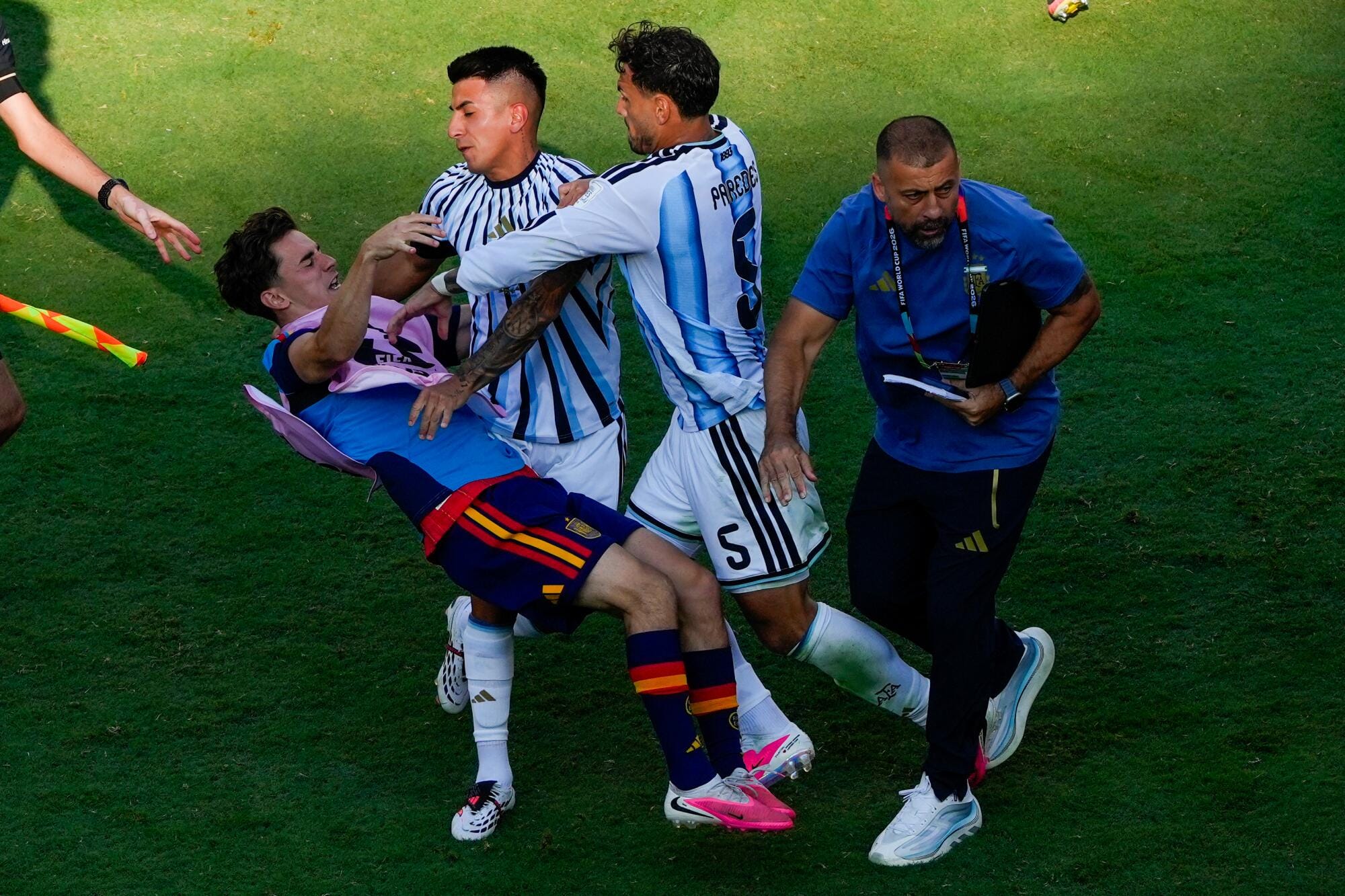
Paredes grabbed Garcia by the throat. Messi shook every hand. Same loss. Same team. Different decisions.
Welcome to Issue 005 of Decoded. The FIFA World Cup final was Sunday night. I've been sitting with something since the final whistle - and it isn't the goal.
⚡ The main idea
Spain beat Argentina 1-0 in extra time on Sunday at MetLife Stadium. Ferran Torres scored in the 106th minute. Spain had twenty shots. Argentina had none on target across ninety minutes of a World Cup final. Enzo Fernandez was sent off just before extra time for a second yellow card. By any measure, it was a deserved Spanish victory and a thoroughly bad night for Argentina.
The match itself is not what I’ve been sitting with.
At the final whistle, Leandro Paredes ran at Spain’s Eric García and grabbed him by the throat. The Argentina coaching staff waded in. There was shoving, bodies colliding, chaos. Alan Shearer and Joe Hart called it disgusting from the studio. They were right. It was.
About twenty metres away, on the same pitch, Lionel Messi was doing something else entirely. He walked - emotional but calmly, deliberately - to each Spanish player in turn, shook their hand, looked them in the eye. Every single one. Not a performance. Not optics. Just a man in the middle of one of the worst nights of his career choosing, very deliberately, who he was going to be in it.
Same defeat. Same dressing room. Completely different people in that moment.
In December last year, I was at the Abu Dhabi Grand Prix - the race where Oscar Piastri lost the F1 World Championship to his own teammate Lando Norris after leading the standings for seventeen of twenty-four races. I crossed paths briefly with Piastri after the race. He was composed, warm, gracious. That moment stayed with me. A few months later, he appeared on the High Performance Podcast in an episode called “The Mindset Secrets of F1’s Calmest Driver” and said something I keep returning to: that being less emotional allows you to think more logically in key decision-making moments.
What I watched Messi do on Sunday was that principle in practice. What I watched Paredes do was what happens when that gap - the one between feeling something and acting on it - closes completely.
👁 On my radar
Three things catching my attention that connect to the same idea.
In 1995, psychologist Daniel Goleman coined the phrase “amygdala hijack” to describe exactly what happened at MetLife Stadium on Sunday. The amygdala - the brain’s threat-detection system - can fire faster than the rational prefrontal cortex catches up, triggering an intense emotional response that bypasses considered thought entirely. Under extreme pressure, the brain can literally override rational choice in milliseconds. What happened to Paredes has a name. Understanding it doesn’t excuse the behaviour - but it changes how you approach the work of training against it.
Nelson Mandela spent twenty-seven years in prison on Robben Island - forced labour, a tiny cell, systematic attempts to strip him of dignity and agency. When he walked free in 1990, there was no bitterness in his public words. No vengeance. Calls for unity instead. He felt everything - anyone who has read his private writings knows that. What he did was hold the emotion long enough to choose his response, rather than letting the emotion choose it for him. Twenty-seven years. And still the gap held.
Canadian astronaut Chris Hadfield trained for years specifically to eliminate panic in genuine space emergencies. His philosophy: competence is the antidote to fear. He rehearsed crisis scenarios so many times that when real emergencies arrived, the emotional response had already been redirected before it could overwhelm. In 2001, an anti-fog solution temporarily blinded him during a spacewalk. He couldn’t see. In space. And he stayed calm - because he had imagined this exact scenario hundreds of times in training and knew exactly what to do. You don’t regulate your emotion in the moment. You practise it long before the moment exists.
↗ The takeaway
The instinct when watching what Paredes did is to reach for a simple verdict: poor character, poor discipline. The behaviour was disgraceful and calling it that is the right thing to do. But the simple verdict misses something important, because it suggests the alternative is easy. It isn’t.
The honest complication is that Paredes didn’t fail because he’s fundamentally different from the rest of us. He failed because emotional regulation under extreme pressure is a trained skill - not a natural state. The people who hold it together under genuine pressure have spent time before the moment identifying their triggers, recognising the early signs, and building the tools to intervene before the emotion runs away. Messi’s composure on Sunday looked effortless. It isn’t. That composure is the product of years of deliberate emotional work.
The specific question for this week: what does your version of the final whistle look like? Not a World Cup - your version. The conversation that goes badly, the public setback, the moment that stings in front of other people. Do you know what your emotional response looks like in those moments? And have you thought - in advance, before the pressure arrives - about who you want to be in them?
🎙 From the pod
Episode 56 of Decoding Wisdom is out! And this week we have Will Bosisto, an Australian professional cricketer who who averaged 276 at the 2012 Under-19 World Cup, captaining a side that included Travis Head, Cameron Bancroft, and Ashton Turner - players who went on to represent Australia at the highest level. He was being compared to Ricky Ponting before he’d played a first-class match. Then Western Australia delisted him at a point in his career when he genuinely believed things were moving in the right direction.
That is a professional gut-punch. The kind that, in the wrong emotional environment, closes a door permanently - not through external circumstance, but through the interior response to it. What Will did instead was move to South Australia, rebuild from the ground up, and find - through the right coaching - a mental clarity that had been missing earlier in his career. He describes the gap between reputation and readiness as the thing he had to close honestly. The quiet inner work that gets you there is exactly the work nobody talks about.
When Will came on Decoding Wisdom recently, that conversation landed differently than I expected. He isn’t talking about technique. He’s talking about the same capacity Messi demonstrated on Sunday night - the trained ability to manage what’s happening inside you when the external situation is at its worst. That’s the episode.

🎧 Watch the full episode here on YouTube
That’s Issue 005 of Decoded. Glad you’re here for it.
If this landed, forward it to one person who needs to hear it. That’s how this grows - one reader at a time.
See you next Tuesday.
Cheers, Sachin.
Like this issue?
Get the next one in your inbox.
That's it for this week. If something here was useful, share it. If it wasn't, let me know - I read every reply.
- Sachin
Share this issue