The “Relative Zero” Theory
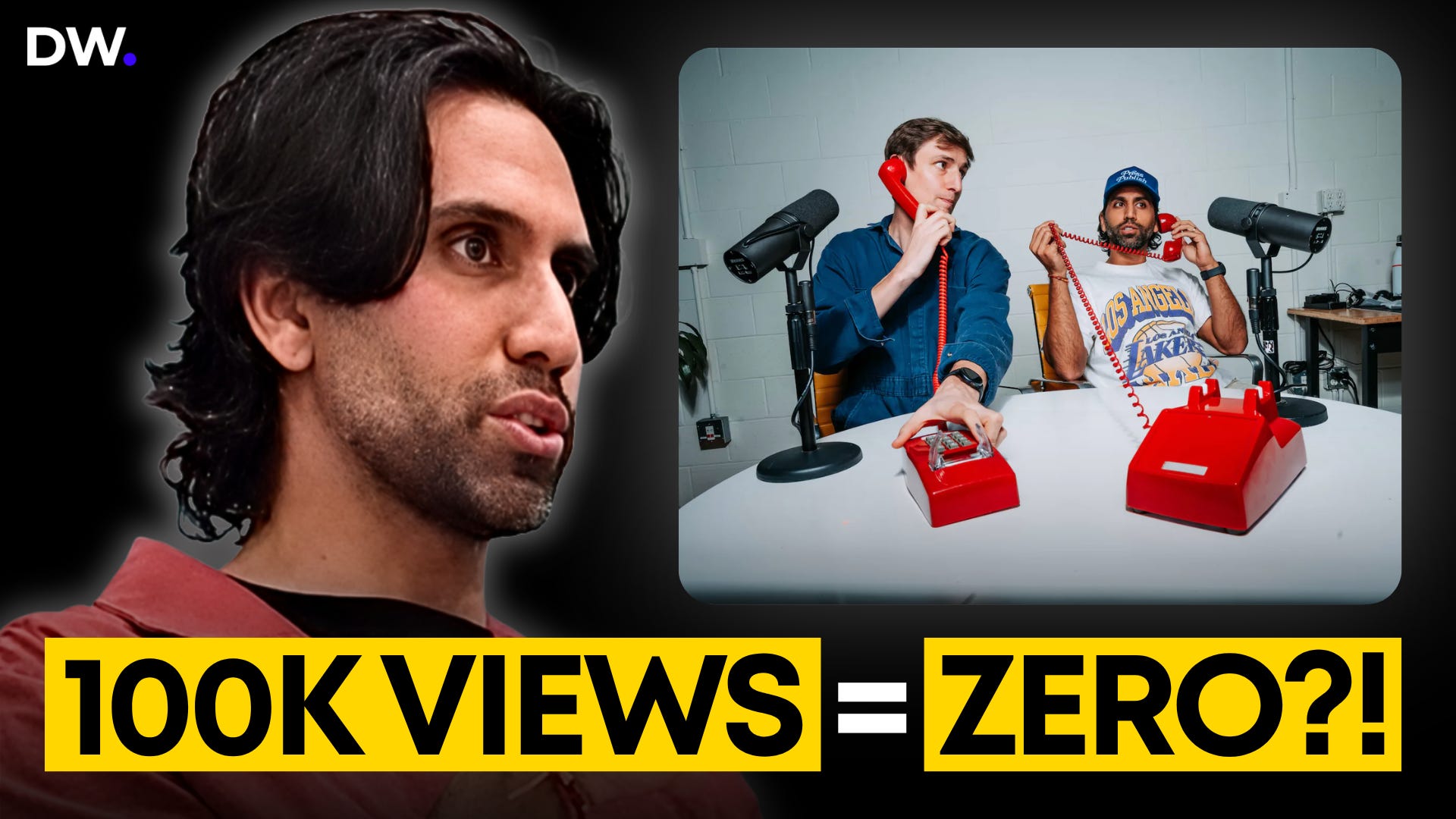
Samir Chaudry told me 100,000 views once felt like zero. I haven't stopped thinking about it.
Welcome to Issue 011 of Decoded. I got seven minutes with Samir Chaudry - the co-host of Colin and Samir, backstage at the 1 Billion Follower Summit in Dubai earlier this year, and one line from that conversation has been sitting with me since. This week’s issue is built entirely around it.
⚡ The main idea
Samir co-founded The Publish Company and co-hosts the Colin and Samir show - if you’ve spent any time near the creator economy, you know the name. He has a theory he calls “Relative Zero”.
Every creator has one, he told me. His example: a video that pulls 80,000 views.
”For us, we had a video last year, we get 80,000 views. And to me that meant zero people watched it. It was painful. For some creators, that’s a million. For some, it’s 10 million. We get to this point in our brains where 100,000 people is no people.”
I know this one personally. My zero used to be whatever view count felt like a win on my very first motorsports reels for @sachinthef1guy - a couple thousand felt massive. Now anything under five figures barely registers, and I have to actively catch myself doing exactly what Samir described.
That’s the part worth sitting with. Zero isn’t a fixed number. It’s wherever your last good result landed. Which means the goalposts you’re measuring yourself against right now were built by you, a few months ago - not by anyone else.
👁 On my radar
Three things catching my attention that connect to the same idea.
Michael Phelps swam to silver in the 200m butterfly at the London 2012 Olympics - a result that would define most careers - and has spoken since about how much that one stung. Years of gold had already reset what a good result looked like for him. His zero wasn’t the podium. It was winning.
Marine biologist Daniel Pauly coined the term “shifting baseline syndrome” in 1995 to describe how each new generation of scientists treats the fish stocks they find at the start of their career as the natural baseline - even though the ocean was already stripped down by the generation before them. Nobody notices the baseline moving because they’re only ever comparing it to their own zero.
There’s a well known 1978 study on lottery winners that found their overall happiness returned close to where it started within about a year of the win. The zero they measured their life against simply absorbed the windfall and moved with it.
↗ The takeaway
Your zero isn’t a fact. It’s a memory of your last good result, dressed up as a baseline. That’s useful - it’s what pushes you to keep raising the bar - but it also means the number that feels like failure to you might be someone else’s dream outcome, and the number that felt incredible eighteen months ago is probably invisible to you now.
I’m not going to tell you to stop moving your zero - ambition needs it to move. But once a week, actually look back at where it used to sit. Not to feel superior about it. Just to remember that the version of you a year ago would have been thrilled with what you’re currently calling “not enough.”
🎙 From the pod
That backstage conversation in Dubai wasn’t just a quick aside - it was Decoding Wisdom Episode 50, “Why Most Creators Burn Out,” recorded the same day we met. The full episode goes deeper into what happens when your relative zero keeps climbing and you don’t notice it moving. The exhaustion isn’t from the work. It’s from chasing a number that used to feel like everything and now feels like nothing.
If the seven minutes above got you thinking, the full episode is where the idea actually gets unpacked properly.
🎧 Watch the full episode here on YouTube
That’s Issue 011 of Decoded. Glad you’re here for it.
If this landed, forward it to one person who needs to hear it. That’s how this grows - one reader at a time.
See you next Tuesday.
Cheers, Sachin.
Like this issue?
Get the next one in your inbox.
That's it for this week. If something here was useful, share it. If it wasn't, let me know - I read every reply.
- Sachin
Share this issue