The Chaos Is The Point.
Ben Stokes retired this weekend. What he never separated is what made him.
Welcome to Issue #2 of Decoded.
I played cricket professionally for the UAE and domestically in the UK. For those of you who already know that - bear with me. For those of you who are new here - now you know.
Cricket was my entire life until I was 22. So when Ben Stokes - one of the greatest to ever play the game, a player I watched make his England debut back in 2011 - announced his retirement out of nowhere this past weekend, hit me hard and I’ve been sitting with it ever since. This one couldn’t wait.
Read on Substack here
⚡ The main idea
Ben Stokes announced his retirement from international cricket. He made the announcement on day four of the third Test against New Zealand at Trent Bridge - while he was mid-bowling-spell. The crowd rose. The next ball, he took a wicket.
Of course he did, as if he knew…
I’ve spent enough time inside this game to know what it actually demands from a person. Not the scorecards version. The real version. And watching Stokes over fifteen years, I kept coming back to something that nobody has said clearly enough: he became the greatest all-rounder of his generation not despite the chaos in his life, but because of what he did with it.

The man himself. Ben Stokes - England's greatest match-winner.
The dominant advice in high performance is compartmentalisation. Keep your personal life separate from your professional life. Leave the noise at the door. Build a clean mental space where nothing from the outside world can get in. It’s in every coaching manual, every performance psychology course, every TED talk about elite sport.
Stokes never read those manuals. Or if he did, he seemed to ignored them.
Think about what this man carried publicly and never once tried to hide from. He was at the WACA in 2013, a young England player, facing Mitchell Johnson on one of the fastest, most cracked pitches in the world - the kind of pitch where the ball is coming at you like it wants to end you. England were falling apart around him. He scored a hundred. He didn’t separate himself from the pressure. He fed on it.
Then came the 2016 T20 World Cup final in Kolkata. West Indies needed 19 off the last over. Stokes was bowling. Carlos Brathwaite hit him for four consecutive sixes. West Indies won the World Cup. That image - Stokes standing at the end of his follow-through, watching the last one disappear into the crowd - became one of the most reproduced moments in cricket’s recent history. It was a public humiliation on the biggest possible stage.
He didn’t retire from that. He compressed it.
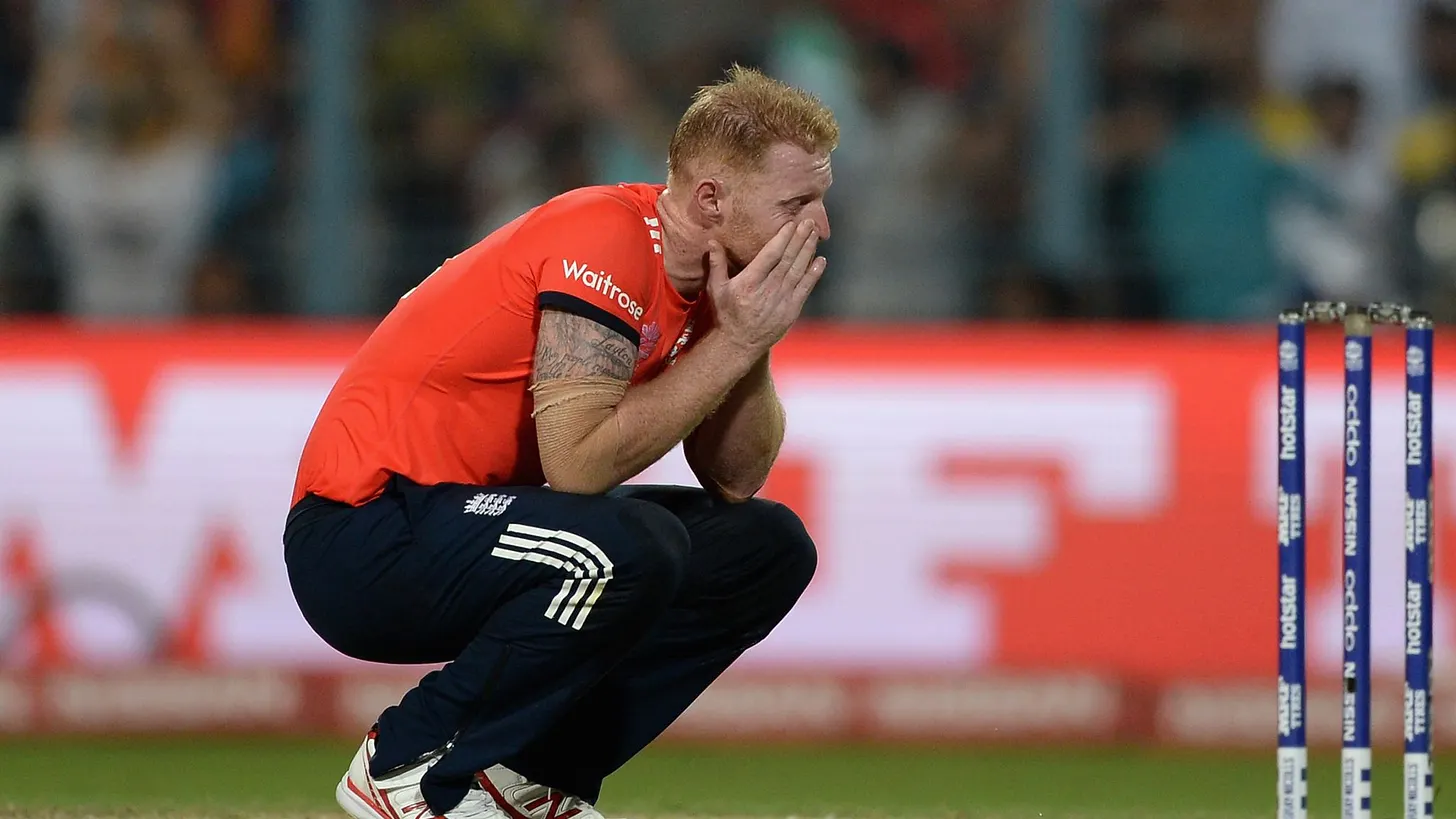
Sometimes despite your best efforts, you’re left in disbelief. Ben Stokes after England lost the 2016 T20 World Cup final.
2017 brought the Bristol nightclub brawl. Criminal charges. He was stripped of the England vice-captaincy and ruled out of the Ashes tour. For most players, that’s the end of the story - the talent that burned too bright and too carelessly. His career should have folded there. Instead, he was acquitted, came back, and rebuilt with something new behind his eyes.
His father Ged died in 2020 from brain cancer. Stokes had already taken compassionate leave to be with him. He later said that when his father died, the person who used to text him after a match to say “well done” was gone - and he had to find something else that could get him going. That is not a small thing to navigate. Most people would close off. Stokes had to find a new source of fire from inside an enormous grief.
In 2021 he took a five-month mental health break. Panic attacks. The accumulated weight of everything. He didn’t hide it. He named it. He went through it. Then he came back and became, arguably, the most transformative Test captain England has ever had - leading a brand of cricket so attacking, so relentless, it had to be given its own name.
And the 2019 Headingley Test. England needed 359 runs in the fourth innings to win against Australia - a target that size at Headingley, in the fourth innings, against a good attack, is essentially asking for a miracle. Stokes scored 135 not out. He didn’t just get England over the line. He dragged them there, inch by inch, with Jack Leach protecting his end and scoring one from 17 balls while Stokes hit 74 off the last 76. England won by one wicket.
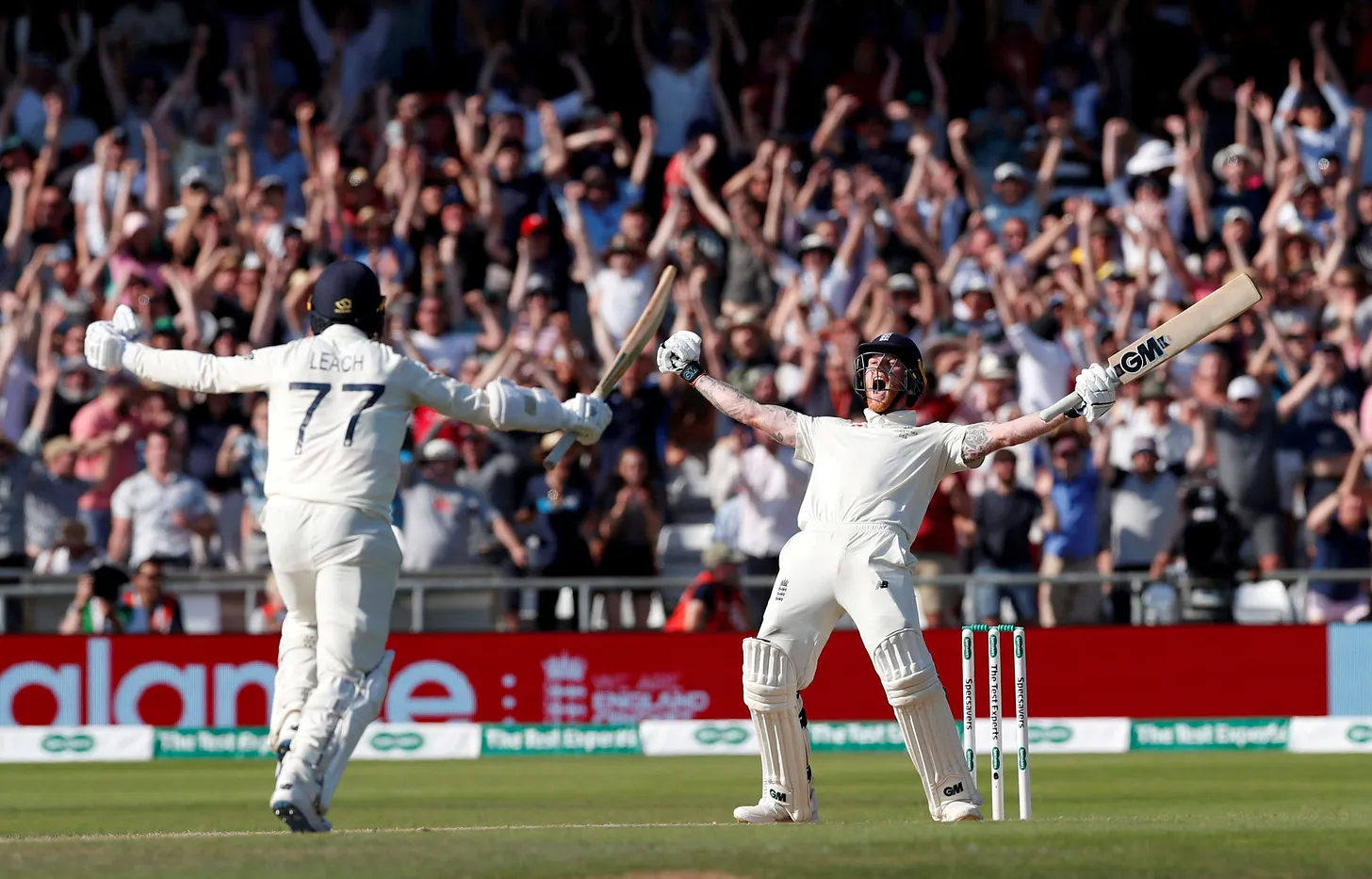
Ben Stokes. Built for the moments that break everyone else.
What do you think was burning inside him during that innings?
Here’s what I’ve come to believe. The conventional view is that chaos is the enemy of elite performance - that the goal is to neutralise it, wall it off, separate your personal life from your professional capability. Stokes ran directly against this. He didn’t put the Bristol brawl on the other side of a wall. He didn’t keep the grief about his father in a separate box. He didn’t pretend the Brathwaite over hadn’t happened and then try to perform cleanly on the other side of it.
He converted all of it. The humiliation, the grief, the public failure, the mental breakdown - none of it was put aside. All of it was fuel.
The chaos wasn’t the obstacle. The chaos was the career.
👁 On my radar
Three things that caught my attention connecting back to the same idea.
- In 1925, Frida Kahlo was eighteen years old when a bus crash shattered her spine, her pelvis, and her right leg - an injury she would manage in pain for the rest of her life. She didn’t put the suffering aside so she could paint. She painted because of it. Her most celebrated works - “The Broken Column”, “The Two Fridas” - are the pain itself, converted directly into image. Nobody told her to separate the chaos from the canvas. She understood instinctively that the canvas was where the chaos went. The suffering wasn’t despite the art. It was the source.
- Steve Jobs was pushed out of Apple in 1985 - humiliated, publicly, from the company he had built. The standard advice at that point would have been to take time away, recover, get some distance. He immediately started two companies. NeXT became the foundation for what Apple would later become when he returned. Pixar became one of the most influential animation studios in history. He later said the firing was “the best thing that could have ever happened to me” - not as a piece of comforting retrospective wisdom, but as a precise description of the mechanism. The humiliation wasn’t compartmentalised. It was the material he worked with.
- By 1802, Beethoven was going deaf. He wrote a private letter - now called the Heiligenstadt Testament - describing the depth of his despair, what it meant to lose the one thing a composer is supposed to need. Then he composed his Fifth Symphony. His Seventh. His Ninth - completed when he was entirely deaf, when he had to feel the vibrations through the floor at the premiere because he could no longer hear a note. He didn’t compose around his deafness. He composed through it. The work didn’t shrink under the chaos. It expanded.
↗ The takeaway
Most high performance advice is built around the idea of separation - put the personal chaos over here, the professional performance over there, build the wall high enough and the noise can’t get in. The problem is that the wall doesn’t just keep the chaos out. It keeps the fuel out too.
What Stokes, and Kahlo, and Jobs, and Beethoven all point toward is a different mechanism entirely. Not compartmentalisation. Conversion. The ability to take the things that happen to you - the public humiliation, the grief, the failure, the physical breakdown - and find a way to put them somewhere useful. Not immediately, not without real cost, and not without risk. Stokes nearly buckled under the weight in 2021. The chaos can eat you. The point isn’t to seek it out and collect it.
The point is to stop pretending the wall is the answer. Think about what you’ve been keeping separate from your work. The thing you’re managing around, the thing you’re trying to protect your performance from. There’s a real possibility it belongs inside the work - not walled off outside it. Not as therapy. As fuel.
🎙 From the pod
When ex-Formula 1 and current IndyCar driver Marcus Ericsson sat down with me on Decoding Wisdom, he’d just come off a 2025 IndyCar season where he felt he had more to prove than ever. And his story, when you lay it out, is essentially the same mechanism Stokes operated on. 97 Formula 1 races without a realistic shot at winning. Then Kimi Raikkonen - a world champion, one of the most celebrated drivers in the sport’s history - needed a seat at Sauber. Ericsson was moved aside. Written off. The performance data said his moment had passed.
He went to IndyCar instead. In 2022, he won the Indianapolis 500 - one of the most prestigious motorsport trophies in the world. When I asked him about the mental side of performing under that kind of pressure, he said something I haven’t been able to shake: that mental strength matters more than anything you can do in a gym. He didn’t mean mantras. He meant the ability to take what’s happened to you - being replaced, being publicly measured and found wanting, having the door closed on you - and convert that into something cold and useful. He didn’t separate the humiliation of being written off from his IndyCar performances. He put it in the car with him.
That’s exactly the chaos channel Stokes ran on. And this conversation will hit differently after reading this week’s issue.

🎧 Watch the full episode here on YouTube.
That’s Issue #2 of Decoded. Glad you’re here for it.
If this landed, forward it to one person who needs to hear it. That’s how this grows - one reader at a time.
See you next Tuesday.
Sach x
Like this issue?
Get the next one in your inbox.
That's it for this week. If something here was useful, share it. If it wasn't, let me know - I read every reply.
- Sachin
Share this issue